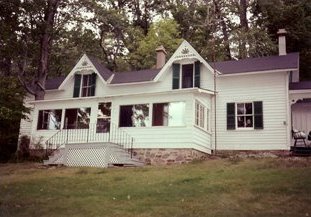
Darling House 1993
Projects
Darlingside
The Darlingside site is located on the St. Lawrence River just east of the Thousand Islands Bridge. Thomas Darling (1813-1882) and his wife Janet Findlay (1825-1906) came to the area from Berwick, Scotland in 1837. Mr. Darling began a cordwood business in 1837. At that time, trade in cordwood figured significantly in the economy of the Township. Local residents from as far north as Blue Mountain would bring wood to Darling’s depot. In turn, Mr. Darling would supply wood to steamers traveling along the St. Lawrence River.
As his business flourished, Darling recognized the need for a general store. His situation was ideal to serve both those in the Township and the steamers. The store was opened in 1845. It was closely associated in a barter-and-credit system of trade with the wood business. This type of trade was very common in early Canada. Little cash would change hands, but products, both raw and finished, would.
In 1851, Thomas Darling purchased Lot 24, Concession 1 of what was then Lansdowne Township. He paid 125 Pounds for the property. Later that same year, Darling purchases Lot 1 Broken Front of Escott Township for 200 Pounds. This property was comprised of 200 acres. Darling was also granted Commons Lot A Broken Front of Escott Township from the Crown in 1856. This land was comprised of 7.5 acres. Thus, the larger property known as Darlingside was assembled. During the later half of the nineteenth century and into the twentieth century, members of the Darling family purchased a substantial amount of property.
From the 1845 census, it is evident that at that time the Darling family only consisted of Thomas and Janet Darling. Eventually, they had ten children. Two of the eldest boys died at very young ages. The majority of the family is buried in Lansdowne Cemetery.
Excellent records remain of this important family. Early Census Records are with the Leeds and Grenville Branch of the Ontario Genealogical Society. In addition, the wills of the Darling family are recorded on microfilm and can be found at the Land Registry Office in Brockville.
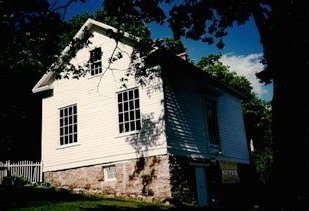
Darling Store
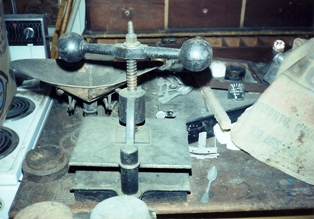
Scales
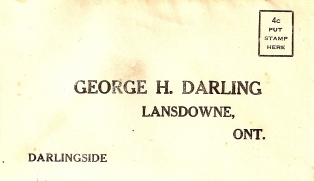
Envelope from the Darling Business
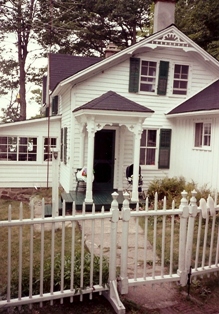
Darling House, east end
The architecture of the Darlingside buildings is also of significance. On Lot 24, Concession 1, there are four buildings: the Darling General Store, the house, a barn and a boathouse. The house and store are of the greatest importance. The store was operated from the 1840’s to the 1890’s. Its architecture provides a good representation of the American Classical/Georgian style. Considering its age, the store is in amazing condition, virtually unaltered from its original state. The store records and ledgers are very well preserved in the archives mentioned above. They provide great insight into the lives of a middle class mercantile family in Upper Canada. There is also preserved original merchandise dated to the 1800’s.
The Darling family made an important contribution to the history of the Thousand Islands Region. They were pioneers in Upper Canada. They continued their mercantile business into the Railway Era. The family was also prominent politically in township and country government. Since the 1940’s, the Darling family have used Darlingside as a summer home.*
* Information compiled by Lisa Thompson and first published in the January 1994 newsletter.
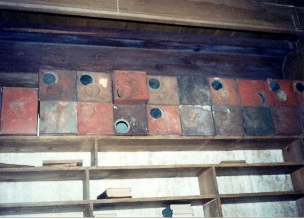
Tea Bins
Each of the Darling children was unique and, to some, eccentric. The Darling girls were well educated. Each boy, with the exception of Arthur Darling, was also extensively involved in the community. The family exercised considerable power in the community because of its economic status. Some of the Darling men held public offices. For example, Thomas Darling was Reeve of Lansdowne Township during the 1860-70’s. His son, Thomas J. Darling, was Reeve in the 1880-90’s. J.D.W. Darling was Township Clerk during the 1880’s, a Justice of the Peace in Lansdowne during the early part of this century, and also operated an insurance company in the village. One of the girls, Margaret, provided mortgage funds for many of the farmers starting up in the area. George was a tea merchant who sold tea throughout eastern Ontario and New York State. The family were staunch Presbyterians and active in the support of the church in Lansdowne. Much of this information is available at Queen’s University Archives as well as the Provincial Archives in Toronto.
Darlingside Honoured with National Recognition …
The Historic Sites and Monuments Board of Canada designated Darlingside as a National Historic Site in a plaque-unveiling ceremony on Saturday September 20, 2000. Three plaques have been placed in the parkette above the Darlingside property, just east of the Thousand Islands Bridge. They picture the Darling store and the Thousand Islands area, and outline the importance of this business to the early St. Lawrence shipping business.
The event was chaired by Dr. Jacques Monet of the Historic Sites and Monuments Board of Canada. Reeve Harold Grier brought greetings from the Township; and Alan Lindsay, President of the Historical Society, spoke of the Darling family and their business interests. Guest speaker was Joe Jordon, Member of Parliament, Leeds-Grenville.